
Black Business, Culture, History & News
Explore Black-owned businesses, community discoveries, society, news, history, and press releases that inform, inspire, and connect our communities. Learn About "US"
The Pilots America Was Sure Would Fail — and the Red Tails That Proved Them Wrong
Support Black Owned Editorial Team Black History
The True Story of the Tuskegee Airmen
A Story Worth Telling
High above the mountains of Italy, a young man crouched inside a giant bomber plane. The sky around him was full of noise and smoke. His plane was big and slow and packed with bombs. It could not turn fast. It could not run.
Then he saw them. Enemy fighter planes, fast and sharp, dropping out of the clouds like hawks. They were coming straight for his bomber. His heart pounded. He knew what enemy fighters did to slow bombers. He gripped his seat and waited for the worst.
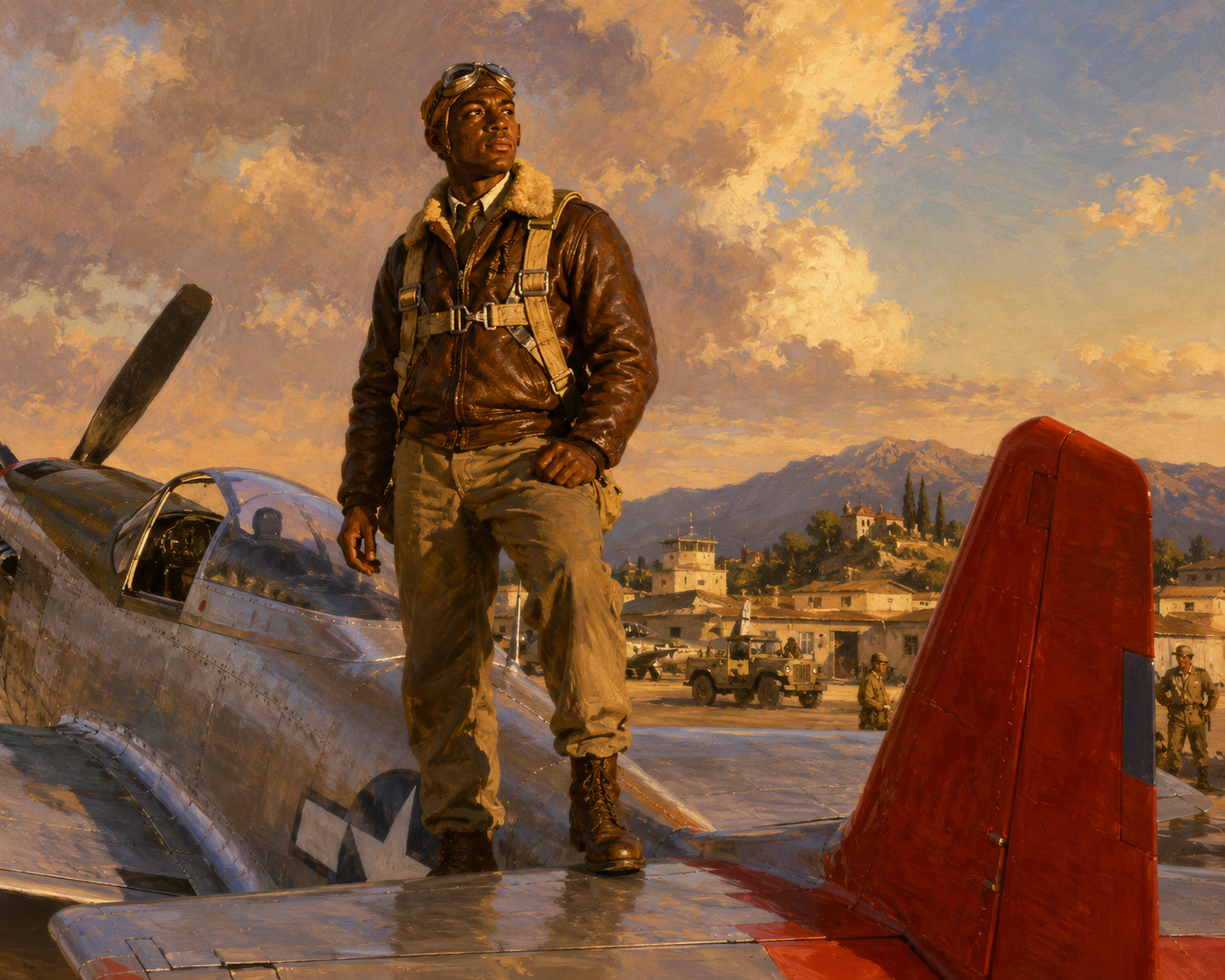
And then, far off, he saw something else. More planes were racing toward them. But these planes were different. Each one had a tail painted a bright, blazing red. The young man did not yet know who was flying them. He only knew one thing in that moment: help was coming fast.
Who were the pilots with the red tails? To understand that moment in the sky, we have to go all the way back — back to a small town in Alabama, and to a group of men who were told, over and over, that they would never fly at all. It is one of the bravest Black history stories ever told.
Who Were the Tuskegee Airmen?
The pilots with the red tails were called the Tuskegee Airmen. They were the first Black pilots ever to fly for the United States military. They got their name from the place where they learned to fly: a training field near the town of Tuskegee, Alabama.
Their story began in 1941, during World War II. Back then, the United States needed pilots badly. But the country had a rule that feels very wrong to us today. Black Americans and white Americans were kept apart. This was called segregation. Black people had to use separate schools, separate buses, and even separate water fountains.
Many powerful people believed Black men were not smart enough or brave enough to fly a fighter plane. They were sure of it. So when the army finally agreed to train Black pilots, some of them expected the whole thing to fail. They even had a cold name for it. They called it “the Tuskegee Experiment.” An experiment is a test. These men were being set up, in part, to prove a hurtful idea true.
But the young men who showed up to fly had a different plan. They were going to prove that idea wrong.
A Country That Did Not Believe in Them
Can you imagine being told you will fail before you even begin? That is what these men faced. They came from all over the country. Some were college students. Some had dreamed of flying since they were boys watching planes cross the sky. They were smart, strong, and ready. But the world around them kept telling them no.
The town near the airfield was segregated, just like the rest of the South. The men could fly planes for their country, but they could not always eat in the same restaurants as white soldiers. Sometimes they were treated worse than prisoners of war who had fought against America. That stung deeply.
Here’s the thing, though. The men did not let the unfair rules shrink their dreams. They studied harder. They flew longer. They knew that every mistake would be used against them, and that every success would have to be twice as good to even count. So they made themselves twice as good.
The Hard Road
One of the leaders of the group was a man named Benjamin O. Davis Jr. He had gone to a famous military school called West Point. While he was there, the other students decided to punish him for being Black. For four long years, almost no one spoke to him. He ate alone. He had no roommate. Nobody told him why.
Most people would have quit. Davis did not. He stayed quiet, did his work, and graduated near the top of his class. That same strength is what he brought to the Tuskegee Airmen. He told his pilots to be calm, be excellent, and let their flying do the talking.
The training itself was brutal. The men trained in the hot Alabama sun, day after day. Many washed out and were sent home. The ones who made it earned a pair of silver wings to pin on their chests. When they finally got those wings, they were not just pilots. They were a promise kept to themselves and to everyone who believed in them.
And here is something easy to forget. It was not only the pilots who made the Tuskegee story possible. There were mechanics who kept the planes flying. There were nurses, instructors, and crews who worked long hours behind the scenes. Thousands of people, in all, were part of the effort. Every one of them faced the same unfair rules, and every one of them chose to do their job with pride anyway.
The Red Tails Take to the Sky
At last, the Tuskegee Airmen were sent to the war in Europe. The first group, called the 99th Fighter Squadron, flew over North Africa and Italy. More squadrons followed, joined together into a unit called the 332nd Fighter Group. Benjamin O. Davis Jr. was their commander.
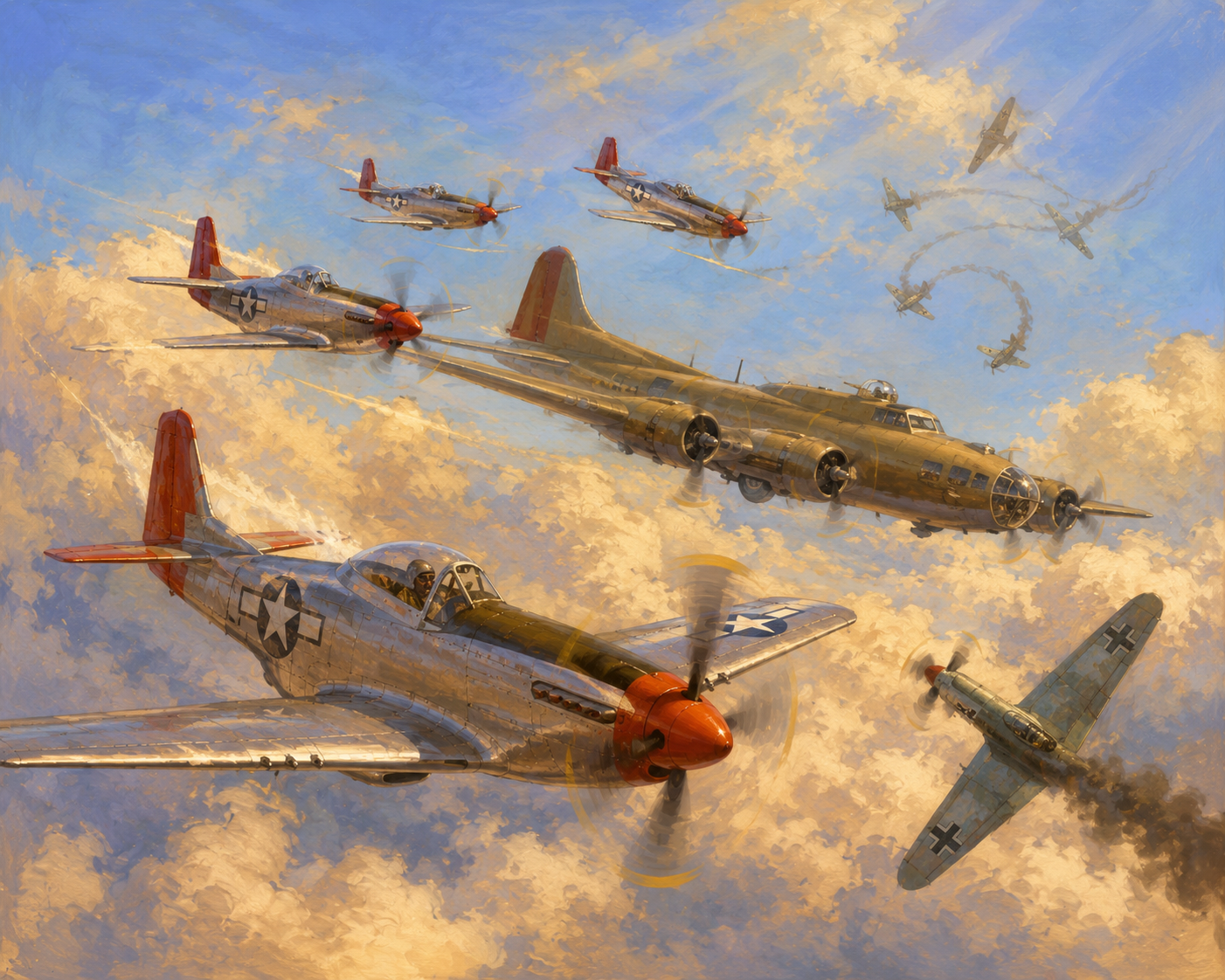
Soon the men were given a powerful new plane, the P-51 Mustang. It was fast and sleek, one of the best fighters of the whole war. The pilots painted the tails of their planes a bright red so they could find each other in the sky. That red tail became their mark. It is how they earned their famous nickname: the Red Tails.
Their main job was to protect the big bombers. Bombers carried heavy loads and flew slowly, so enemy fighters loved to hunt them. Some fighter pilots liked to chase enemy planes far away to win glory for themselves. But the Red Tails made a choice. They stayed close to the bombers they were guarding, like a shield that would not break.
Word spread fast among the bomber crews. The men flying those slow, heavy planes started to notice that when the red-tailed fighters were guarding them, they felt safer. Crews began asking for the Red Tails by name. They did not care what color the pilots were. They cared that these pilots stayed with them when it mattered most.
The Red Tails were not magic, and the war was not a movie. People sometimes say they never lost a single bomber, but that is not quite true. War is dangerous, and some bombers under their watch were still shot down. What is true is that the Red Tails lost very, very few — far fewer than most. They flew with such skill and such heart that crews trusted them above almost anyone. That trust was something they earned, mission after mission.
What It All Meant
By the end of the war, nearly one thousand pilots had trained at Tuskegee. About four hundred and fifty of them flew in combat overseas. Together with their mechanics, nurses, and crews, they shot down enemy planes, destroyed targets on the ground, and brought countless bomber crews safely home.
They had been handed a test meant to prove they could not do it. Instead, they passed that test so completely that they changed minds across the whole country. Their record helped push America to make a huge decision in 1948: the military would no longer keep Black and white soldiers apart. The Red Tails had helped crack open a door that had been locked for far too long.
The army noticed, too. The 332nd Fighter Group earned a special honor called a Distinguished Unit Citation for one daring, long mission deep into enemy territory. That award is given to whole groups that go above and beyond. Slowly, the same country that once doubted these men began pinning medals on their chests. The truth had become too loud to ignore.
Back to That Moment in the Sky
Now let’s go back to where we started. Remember the young man in the bomber, watching enemy fighters dive toward him, and then spotting planes with bright red tails racing to help?
Those red-tailed planes were the Tuskegee Airmen. They swept in between the bomber and the enemy. They turned and twisted and drove the attackers away. And when the danger had passed, they did not fly off looking for glory somewhere else. They stayed. They flew beside that bomber all the way home.
The young man in the bomber may never have learned their names. But he never forgot the red tails. Crews like his carried that memory for the rest of their lives — the day they were saved by the very pilots their country had bet would fail.
Many years later, in 2007, the United States gave the Tuskegee Airmen its highest honor, the Congressional Gold Medal. By then, most of America finally understood what those bomber crews had known all along. You can find more inspiring true stories like this one waiting to be discovered.
So the next time someone tells you what you cannot do, remember the men who painted their tails red. Remember that they were told no a thousand times, and they flew anyway. Their story — and so many more — is kept alive at SupportBlackOwned.com, because some stories are simply too brave to forget.
We are Black, Proud, and Powerful. 🖤💚
Editorial Note: This article was developed with assistance from AI tools and reviewed, edited and approved by the Support Black Owned Editorial Team. Business information was checked using available sources and information provided by the featured business.


Woman- and minority-owned commercial cleaning and janitorial…